
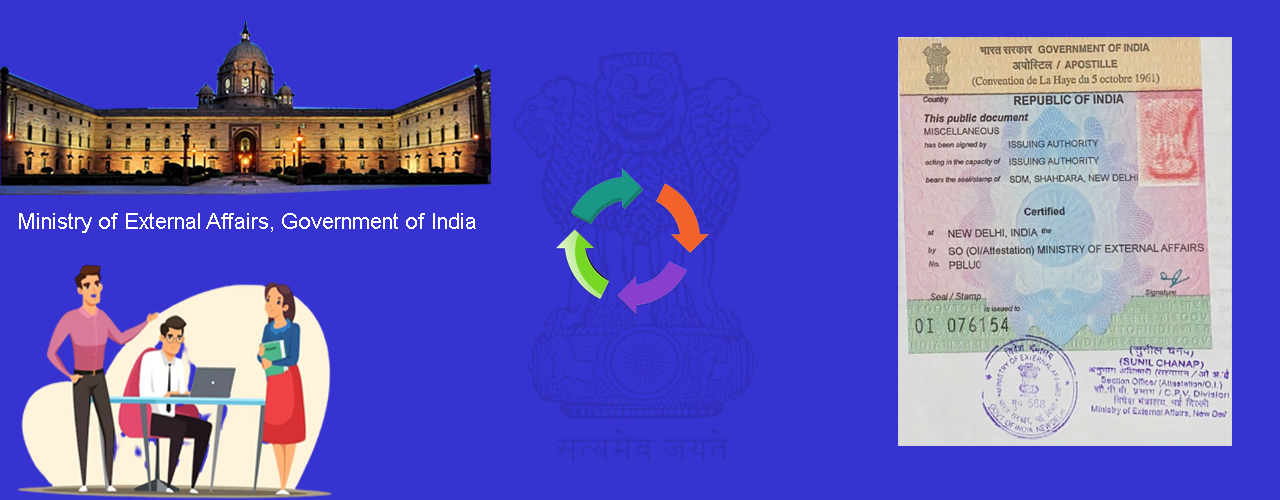
An apostille is a type of attestation in which the legalization of documents is accomplished in a certain format that is recognized by all parties to the Hague Convention. In essence, an apostille is a type of international attestation that is approved in 92 countries and is widely accepted in the Western world.
The Ministry of External Affairs, Government of India, paste an apostille stamp, which is a square-shaped computer-generated sticker stamp, on the back of the document. Any member nation of The Hague Convention may validate the legitimacy of this one-of-a-kind computer-generated stamp online using its unique identifying number.
OM Travels Apostille Services does every single step in a detailed manner. We deliver a hassle-free experience to those approaching us for attestation. Note: Only after attestation by the pertinent state authorities is an MEA's attestation or apostille completed.
In most cases, the document only needs to be attested once by the relevant embassy once it has been apostilled. A document does not need to be attested once it has been apostilled.
In a formal environment, an apostille is essentially a formality to prove the legitimacy and reliability of the document. According to the dictionary, the word "apostille" simply means "certification" in French.
An apostille sticker and/or an apostille stamp are obtained from the authorities when you apostille a document. It is computer generated and attached on the back of the paper with a special identification number.
This keeps a record online and makes it easier for the relevant authorities to check the veracity. Usually, no further confirmation from the embassy is required after this MEA label has been applied.
To make the required documents admissible in any country that is a signatory to the Hague Convention, they can be attested using an apostille. Apostille is a kind of international attestation that is accepted as valid in more than 116 countries.
Apostille Attestation is needed in the majority of European and American nations. In India, a sticker from the Ministry of External Affairs adheres to the document's back, and once more, the stamp is applied to the sticker so that it appears on both the sticker and the paper.
When traveling to foreign countries for a variety of reasons. These include obtaining a work visa, applying for a temporary or permanent residence permit, enrolling in school on a student visa, or conducting business expansion transactions such as importing or exporting goods.
Apostilling of documents is necessary for all the mentioned reasons here. The nations that are a part of the Hague Convention are required to meet this stipulation.
On October 5, 1961, in the city of Luxembourg, the Hague Convention, commonly known as the Apostille Hague Convention or Apostille Convention, was ratified. However, it wasn't until January 14th, 1965 that it went into force.
The convention was put into effect to do away with the requirement for legalisation of documents and certificates in order to facilitate easier liberalisation between nations.
Apostilles are not required once they have been obtained on papers for one signatory country to another. There are fewer restrictions in trade and other areas, and access is improved among the countries.
There are around 116 countries that make up the Hague Convention on Apostilles, and only for these countries do documents need to be apostille. Here is a list of every nation that has ratified the Hague Convention:
We have listed the Hague Convention Countries below
India is a developing nation that has expanded since gaining its freedom. Everything naturally progresses—the economy, fields of study, work opportunities—and over time, more Americans are travelling abroad.
This highlights the required for the issue of an employment visa, a student visa, a resident visa, or the need for certificate attestation in order to conduct business abroad. Indian apostille has facilitated the aforementioned procedures.
Since joining the Hague Convention in 2005, India is acknowledged in practically all of the signatory nations. The name of the applicant, the name of the document, the name of the officer who issued the sticker and stamp, and the date of issuance are all included on the sticker that the Ministry of External Affairs (MEA).The apostille sticker is valid for six months in India. Before addressing the MEA, the technique is an indirect course of action that involves easy attestation from the regional and state government.
The apostille process was recently devolved by the Indian national government. The principal agency in charge of completing document apostille is the Ministry of External Affairs (MEA).
The apostille process has been regionalized by the MEA to Branch Secretariats and RPOs in 15 cities as of January 1st, 2019. New Delhi, Thiruvananthapuram, Hyderabad, Mumbai, Ahmedabad, Bengaluru, Chennai, Bhopal, Cochin, Lucknow, Chandigarh, Guwahati, Kolkata, Raipur, and Panaji are among the cities in which the company operates.
The process typically starts with the local notary where the paper was signed, is then authenticated by the state, and finally is stamped with the MEA apostille.
Regarding various document kinds, the method makes distinctions. Personal, educational, and commercial legal documents are the three main categories.
Following are the steps are described in detailed:
The title "personal document apostille" makes it very apparent that it is the legalization of documents that contain personal data. It includes the apostille for both the birth and marriage certificates.
The following flow make up the apostille process for personal documents:
1. Notary Attestation
2. Home Department Attestation
3. Apostille from the MEA
Educational documents are records of your academic accomplishment and the courses you have completed over time. They serve as evidence of your educational history. The most typical academic documents of:
Depending on the origin or type of the document, several procedures must be followed when attesting educational certificates.
Commercial documents are those that permit any entrepreneur to own capital for their business. These comprise of documents including, among others, wills, partnership agreements, and memoranda of alliances.
The flow for the commercial document apostille process is as follows:
Notary Attestation : Obtaining a Notary's certification for the educational and personal documents is the first stage in their authenticity. At the local level, it is handled by a lawyer or the collector's office.
The Home Department, a state-level organisation, certifies the personal documentation. It is responsible for certifying papers that come from the same state government. The Home Department, often referred to as Mantralaya in some states, goes by the moniker Mantralaya Attestation.
Only the state's HRD, or Human Resource Department, is in charge of certifying academic transcripts. The offered authentication component primarily depends on certificate validation. A university or board must verify the certificate, depending on where the document was issued.